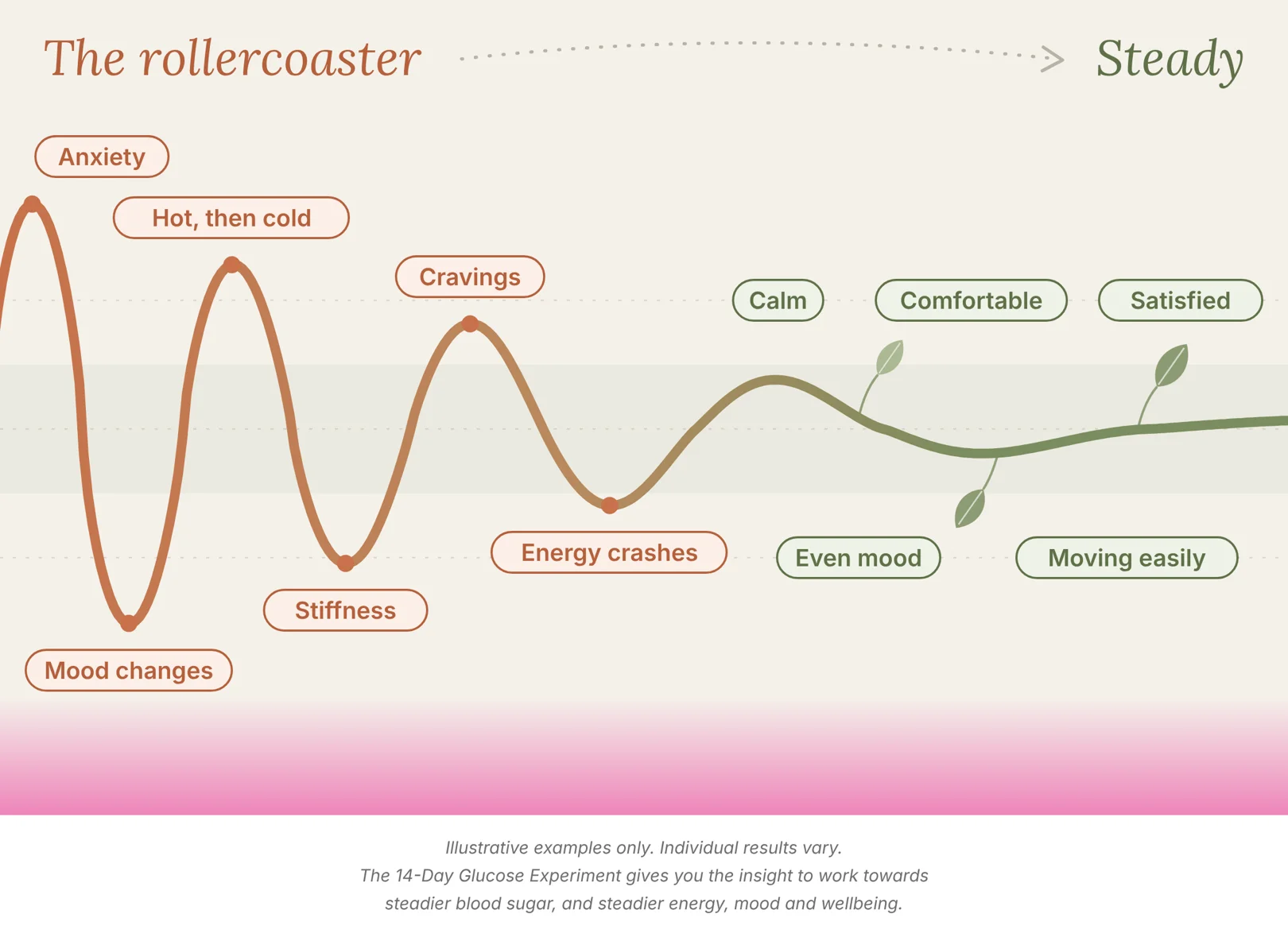
Tired all the time. Hangry by mid-afternoon. Anxious, or feeling irritable. Stiff, achy joints. Craving something sweet after dinner, or waking in the night and unable to get back to sleep. Many women describe days like these, and blood sugar can be part of the picture.
How your body handles blood sugar is a big part of your metabolic health, which is how well your body turns food into steady energy. It’s also personal. Two women can eat the same lunch and have very different responses. A glucose sensor lets you see what your own body is doing, day and night, for 14 days.
Same food, different response
In a UK study of just over 1,000 adults, people ate identical test meals while wearing a glucose sensor at home. The rise in blood sugar after the same meal varied widely from one person to the next [1]. An earlier study of 800 people in Israel found the same [2].
General advice about “healthy” and “unhealthy” foods can only take you so far. Your own data shows how your body responds.
A typical day
Blood sugar rises after you eat, and that is expected. In a US study of 153 healthy people without diabetes, aged 7 to 80, sensor readings sat between 3.9 and 7.8 mmol/L for about 96% of the day. Readings went above 7.8 for roughly half an hour a day [3].
So a rise after a meal is no cause for worry on its own. A sensor shows you how high it goes and how quickly it comes back down. Over 14 days, you also start to see what tends to drive it, and connect it to how you feel.
The dip after the rise
The fall after a meal can matter as much as the rise. In a UK and US study of more than 1,000 people, those whose blood sugar dropped furthest below their starting level two to three hours after eating tended to feel hungrier sooner. Over the following 24 hours they ate about 312 calories more than the people with the smallest dips [4].
Many women will recognise that mid-afternoon dip, when you find yourself reaching for something for a quick pick-me-up.
Energy, mood and sleep
Fast-releasing carbohydrate, such as white bread or sugary drinks, sends blood sugar up quickly and often down again. Eating a lot of it has been linked with how people feel day to day.
In a controlled feeding study, adults felt more tired and lower in mood after four weeks on a diet high in fast-releasing carbohydrate than on a slower-releasing diet with the same calories [5]. In a large US study of postmenopausal women, the same kind of diet was linked with higher odds of depression and insomnia [6,7]. Neither study used a glucose sensor, so they can’t show what blood sugar was doing hour by hour. A sensor lets you see that for yourself.
Sleep plays a part too. In the UK study mentioned earlier, a broken night or a later bedtime than usual was linked with a bigger blood sugar rise after the next morning’s breakfast [8]. A difficult day on your sensor may be about last night as much as about what you ate.
Stress hormones such as cortisol prompt the liver to release glucose and make insulin work less well [9]. Blood sugar can rise without any food at all.
Hormones and blood sugar
Hormones shape blood sugar right through life. Across a menstrual cycle, blood sugar tends to shift a little with each phase. In a sensor study of 49 women without diabetes, average glucose was lowest in the days just before ovulation and highest in the second half of the cycle, in the days before a period [10]. A larger study of 257 women found insulin worked slightly less well in that second half too [11]. The changes were small, and a sensor can pick them up.
Oestrogen helps insulin do its job in your muscles and liver [12]. As oestrogen levels change and then fall through perimenopause and menopause, many women find their blood sugar becomes less predictable [13].
The UK study looked at this too. Women after menopause had, on average, a larger blood sugar response to meals and poorer sleep than women before menopause. HRT was linked with more favourable fasting glucose [13].
What this can mean for you
When blood sugar runs higher or swings more, you may notice it in how you feel day to day. It also matters for your health over the years.
- A review of 15 studies in women aged 18 to 45 found they ate on average around 170 calories a day more in the second half of the cycle than in the first [14].
- When blood sugar genuinely drops too low, which is uncommon in people without diabetes, the body releases stress hormones to bring it back up. That can feel like shakiness, a racing heart or anxiety, and it can be harder to think clearly [15].
- In a large US study following more than 3,000 midlife women for eight years, more frequent hot flushes were linked with slightly higher insulin resistance, even after taking body weight into account [16]. In one small experiment with ten women who had paused their HRT, hot flushes were less frequent while a glucose drip kept their blood sugar at about after-meal levels than while they were fasting [17].
- Through the menopause transition, fat tends to move towards the middle, including the deeper fat around the organs. This deeper fat is linked with insulin working less well, so blood sugar can become harder to keep steady, and over time the risk of heart disease rises faster [18,19].
Your blood sugar can become steadier, and metabolic health can always be improved, whatever your stage of life. Rebalancing your metabolic health supports you through menopause whether you decide to use HRT or not.
If you still have periods, note where you are in your cycle while you wear a sensor. It helps make sense of what you see.
Reading your sensor
A glucose sensor is a small disc worn on the back of your arm. It reads the fluid just under your skin, which runs a few minutes behind your blood [20].
- Look at the overall pattern of your day, rather than any single reading.
- Lying on the sensor at night can cause false low readings [21].
- A wellness sensor is not a diabetes test [22]. If you’re worried about diabetes, your GP can arrange an HbA1c blood test.
Research on sensors in people without diabetes is still young [23]. In my Root Cause Clinic, I see how valuable it is for women to understand how their body responds to food, movement, sleep and stress. That insight helps them make positive changes that improve how they feel.
Use a sensor as a learning tool, and read your results with someone who can put the numbers in context.
The 14-Day Glucose Experiment
For 14 days you wear a small glucose sensor and try one simple experiment a day from your workbook. Each one fits easily into your normal day, and you jot down what your glucose did and how you felt. It’s a chance to get curious about your own body and see what it tells you.
Then we meet, in my Root Cause Clinic in North Somerset or online, to go through what you found. You’ll leave with a one-page summary of the meals that held you steady, your biggest spikes and what caused them, and the personalised actions that will have the most impact for you.
£125, including your sensor. Available to book until 31 October. The experiment runs in early November and you choose the start date that suits you best. Places are limited.
Book The 14-Day Glucose Experiment
Sources:
-
Berry SE, Valdes AM, Drew DA, et al. Human postprandial responses to food and potential for precision nutrition. Nature Medicine. 2020;26(6):964-973.
-
Zeevi D, Korem T, Zmora N, et al. Personalized nutrition by prediction of glycemic responses. Cell. 2015;163(5):1079-1094.
-
Shah VN, DuBose SN, Li Z, et al. Continuous glucose monitoring profiles in healthy nondiabetic participants: a multicenter prospective study. Journal of Clinical Endocrinology & Metabolism. 2019;104(10):4356-4364.
-
Wyatt P, Berry SE, Finlayson G, et al. Postprandial glycaemic dips predict appetite and energy intake in healthy individuals. Nature Metabolism. 2021;3(4):523-529.
-
Breymeyer KL, Lampe JW, McGregor BA, Neuhouser ML. Subjective mood and energy levels of healthy weight and overweight/obese healthy adults on high- and low-glycemic load experimental diets. Appetite. 2016;107:253-259.
-
Gangwisch JE, Hale L, Garcia L, et al. High glycemic index diet as a risk factor for depression: analyses from the Women’s Health Initiative. American Journal of Clinical Nutrition. 2015;102(2):454-463.
-
Gangwisch JE, Hale L, St-Onge MP, et al. High glycemic index and glycemic load diets as risk factors for insomnia: analyses from the Women’s Health Initiative. American Journal of Clinical Nutrition. 2020;111(2):429-439.
-
Tsereteli N, Vallat R, Fernandez-Tajes J, et al. Impact of insufficient sleep on dysregulated blood glucose control under standardised meal conditions. Diabetologia. 2022;65(2):356-365.
-
Rizza RA, Mandarino LJ, Gerich JE. Cortisol-induced insulin resistance in man. Journal of Clinical Endocrinology & Metabolism. 1982;54(1):131-138.
-
Lin G, Siddiqui R, Lin Z, et al. Blood glucose variance measured by continuous glucose monitors across the menstrual cycle. npj Digital Medicine. 2023;6:140.
-
Yeung EH, Zhang C, Mumford SL, et al. Longitudinal study of insulin resistance and sex hormones over the menstrual cycle: the BioCycle Study. Journal of Clinical Endocrinology & Metabolism. 2010;95(12):5435-5442.
-
Mauvais-Jarvis F, Clegg DJ, Hevener AL. The role of estrogens in control of energy balance and glucose homeostasis. Endocrine Reviews. 2013;34(3):309-338.
-
Bermingham KM, Linenberg I, Hall WL, et al. Menopause is associated with postprandial metabolism, metabolic health and lifestyle: the ZOE PREDICT study. eBioMedicine. 2022;85:104303.
-
Tucker JAL, McCarthy SF, Bornath DPD, et al. The effect of the menstrual cycle on energy intake: a systematic review and meta-analysis. Nutrition Reviews. 2025;83(3):e866-e876.
-
Ahmed FW, Majeed MS, Kirresh O. Non-diabetic hypoglycemia. In: StatPearls. Treasure Island (FL): StatPearls Publishing; updated 2023. NBK573079.
-
Thurston RC, El Khoudary SR, Sutton-Tyrrell K, et al. Vasomotor symptoms and insulin resistance in the Study of Women’s Health Across the Nation. Journal of Clinical Endocrinology & Metabolism. 2012;97(10):3487-3494.
-
Dormire SL, Reame NK. Menopausal hot flash frequency changes in response to experimental manipulation of blood glucose. Nursing Research. 2003;52(5):338-343.
-
El Khoudary SR, Aggarwal B, Beckie TM, et al. Menopause transition and cardiovascular disease risk: implications for timing of early prevention. A scientific statement from the American Heart Association. Circulation. 2020;142(25):e506-e532.
-
Marlatt KL, Pitynski-Miller DR, Gavin KM, et al. Body composition and cardiometabolic health across the menopause transition. Obesity. 2022;30(1):14-27.
-
Basu A, Dube S, Slama M, et al. Time lag of glucose from intravascular to interstitial compartment in humans. Diabetes. 2013;62(12):4083-4087.
-
Baysal N, Cameron F, Buckingham BA, et al. A novel method to detect pressure-induced sensor attenuations (PISA) in an artificial pancreas. Journal of Diabetes Science and Technology. 2014;8(6):1091-1096.
-
Abbott. What if my glucose reading is higher or lower than I expect? Lingo Support, Glucose Accuracy. https://support.hellolingo.com/hc/en-us/sections/11657284520599-Glucose-Accuracy (accessed 16 October 2026).
-
Klonoff DC, Nguyen KT, Xu NY, et al. Use of continuous glucose monitors by people without diabetes: an idea whose time has come? Journal of Diabetes Science and Technology. 2023;17(6):1686-1697.