Aching hips, stiff knees first thing in the morning, sore hands that make a jar harder to open. Many women put these down to getting older and are left to live with them.
World Menopause Day falls on Sunday 18 October, and this year the International Menopause Society has chosen chronic pain in midlife as its theme. Joint pain is one of the most common ways that pain shows up, and one women are rarely given much help with.
Want it all on one page? Download the free joint pain guide (PDF)
How common it is
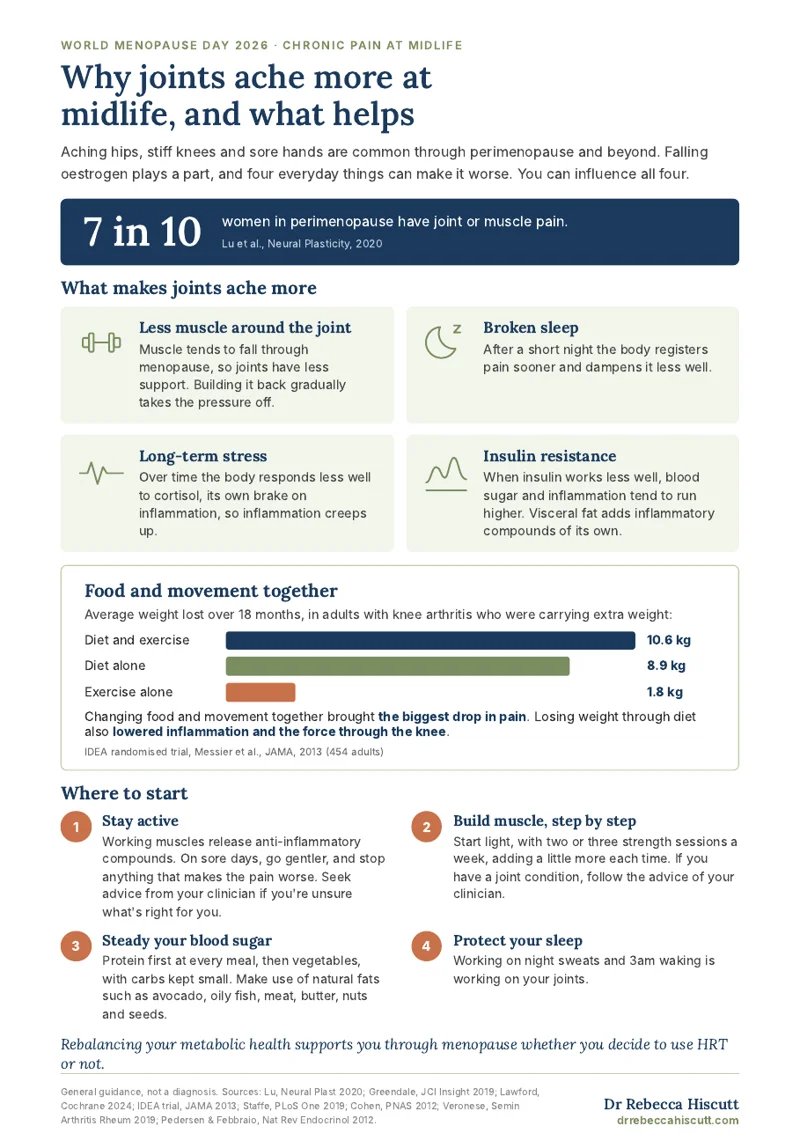
A 2020 review pooled 16 studies and found around 7 in 10 women in perimenopause had joint or muscle pain. A 2024 review estimates that around a quarter of women are disabled by their symptoms, and its authors call this the musculoskeletal syndrome of menopause. It is a proposed name rather than an established diagnosis, but the pain is real.
Falling oestrogen plays a part, and four other drivers can make it worse. You can influence all four.
Less muscle around the joint
Muscle tends to shrink through the menopause transition, so every stair and every step out of a chair puts more load through the joint itself. Building that muscle back gradually takes the pressure off.
In knee arthritis, a Cochrane review of 139 trials and over 12,000 people found exercise eased pain by around 9 points on a 100-point scale. That is a modest effect, but it comes from a very large body of trials.
Broken sleep
Night sweats and 3am waking chip away at sleep through perimenopause. In a lab study, healthy volunteers kept awake for a whole night felt pain sooner the next day, and their bodies were less able to turn it down.
One night without sleep in healthy volunteers is not the same as months of broken nights. Still, many women find everything aches more on the morning after a bad night.
Long-term stress
Cortisol is your body’s own brake on inflammation. When stress runs on for months, the body becomes less responsive to cortisol. The brake is still there, but it grips less well, so inflammation creeps up. Many women feel it in their joints.
Perimenopause often arrives in the busiest years of life, with work and family pulling in both directions. Stress that never quite switches off is common at this stage, and it adds to the ache.
Insulin resistance
Insulin is the hormone that moves sugar out of your blood and into your cells. With insulin resistance, your cells respond less well to insulin, so blood sugar and inflammation tend to run higher.
Metabolic health tends to slip through the menopause transition, often with more fat stored deep around the middle. This visceral fat releases inflammatory compounds, such as IL-6, into the bloodstream. Type 2 diabetes is a recognised risk factor for knee arthritis getting worse. Over the years, sugar can also bind to the collagen in cartilage and stiffen it, and high blood sugar is thought to speed this up.
Food and movement together
The IDEA trial followed 454 adults aged 55 and over, around 70% of them women, who had knee arthritis and were carrying extra weight. For 18 months they were randomly assigned to diet alone, exercise alone, or diet and exercise together. Average weight lost was:
- 10.6 kg with diet and exercise
- 8.9 kg with diet alone
- 1.8 kg with exercise alone
Changing food and movement together eased pain more and made everyday movement easier than either diet or exercise alone. Inflammation was lower in both diet groups than with exercise alone, and the force through the knee was lower with diet alone. Adding exercise to the diet did not lower either further.
This was a group with diagnosed knee arthritis, so the results apply most directly to people like them. For anyone with aching joints, they make a good case for working on food and movement together rather than picking one.
Where to start
- Stay active, and listen to your body. Working muscles release anti-inflammatory compounds. On sore days, choose something gentler, and stop anything that makes the pain sharper or leaves it worse the next day. Seek advice from your clinician if you’re unsure what’s right for you.
- Build muscle step by step. Start light, aim for two or three strength sessions a week, and add a little more each time. Bands, weights and your own bodyweight all work. If you have a diagnosed joint condition, follow the advice of your clinician.
- Steady your blood sugar. Start with protein, fill up with vegetables, and keep starchy carbs to a small portion. Make use of natural fats such as avocado, oily fish, meat, butter, nuts and seeds.
- Protect your sleep. Getting on top of night sweats and 3am waking helps your joints too.
Rebalancing your metabolic health supports you through menopause whether you decide to use HRT or not.
Where to go from here
Joint pain at midlife rarely has one cause, so there is more than one place to start. Whatever your starting point, metabolic health can improve. For many women, the first changes are getting out of a chair without bracing first, or finishing a walk without aching hips.
In my Root Cause Clinic, in person and online, we look at all four drivers together and work out which one to start with for you.
Book your Root Cause Clinic appointment
Sources:
Lu CB, Liu PF, Zhou YS, et al. Musculoskeletal pain during the menopausal transition: a systematic review and meta-analysis. Neural Plasticity. 2020;2020:8842110.
Wright VJ, Schwartzman JD, Itinoche R, Wittstein J. The musculoskeletal syndrome of menopause. Climacteric. 2024;27(5):466-472.
Greendale GA, Sternfeld B, Huang M, et al. Changes in body composition and weight during the menopause transition. JCI Insight. 2019;4(5):e124865.
Lawford BJ, Hall M, Hinman RS, et al. Exercise for osteoarthritis of the knee. Cochrane Database of Systematic Reviews. 2024;12:CD004376.
Staffe AT, et al. Total sleep deprivation increases pain sensitivity, impairs conditioned pain modulation and facilitates temporal summation of pain in healthy participants. PLoS One. 2019;14(12):e0225849.
Cohen S, Janicki-Deverts D, Doyle WJ, et al. Chronic stress, glucocorticoid receptor resistance, inflammation, and disease risk. PNAS. 2012;109(16):5995-5999.
Janssen I, Powell LH, Crawford S, et al. Menopause and the metabolic syndrome: the Study of Women’s Health Across the Nation. Archives of Internal Medicine. 2008;168(14):1568-1575.
Fontana L, Eagon JC, Trujillo ME, et al. Visceral fat adipokine secretion is associated with systemic inflammation in obese humans. Diabetes. 2007;56(4):1010-1013.
Veronese N, Cooper C, Reginster JY, et al. Type 2 diabetes mellitus and osteoarthritis. Seminars in Arthritis and Rheumatism. 2019;49(1):9-19.
Verzijl N, DeGroot J, Ben ZC, et al. Crosslinking by advanced glycation end products increases the stiffness of the collagen network in human articular cartilage. Arthritis & Rheumatism. 2002;46(1):114-123.
Messier SP, et al. Effects of intensive diet and exercise on knee joint loads, inflammation, and clinical outcomes among overweight and obese adults with knee osteoarthritis: the IDEA randomized clinical trial. JAMA. 2013;310(12):1263-1273.
Pedersen BK, Febbraio MA. Muscles, exercise and obesity: skeletal muscle as a secretory organ. Nature Reviews Endocrinology. 2012;8(8):457-465.