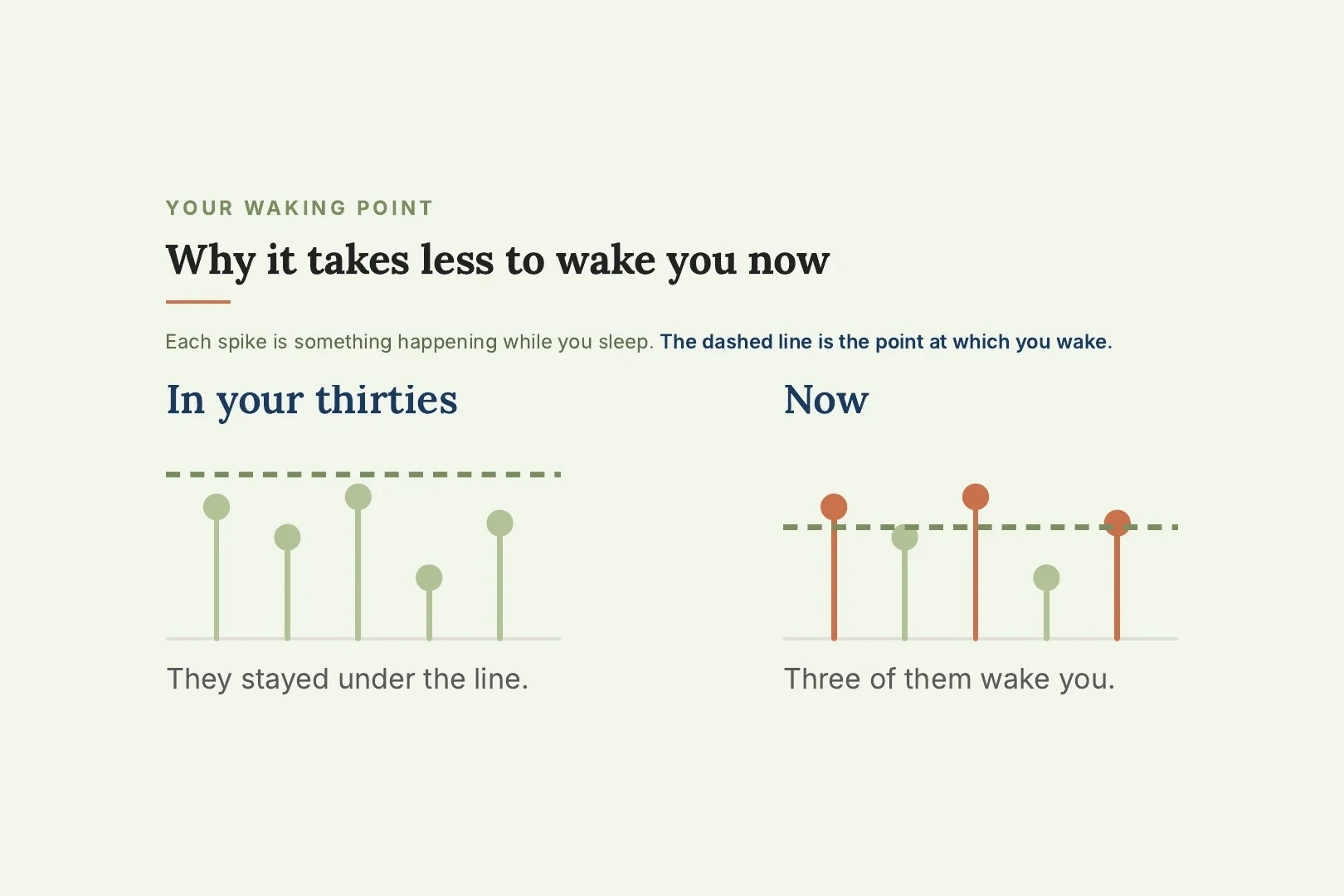
Many women start waking in the small hours during perimenopause. Blood sugar dips through the night, a stress threshold that sits lower than it used to, and a body clock that has moved all play a part. As hormones shift, it takes less to wake you.
On Sunday afternoon we ran a community event, The 3am Club, focusing on sleep. Women were able to talk about their experiences, when they woke up, what impacted this and we discussed strategies to help.
Wide awake at 2.30 or 3am. Heart going, mind whirring, sometimes feeling so hot. Struggling to switch your brain off and fall back to sleep.
Two things were clear before I had taught anything. How many women were waking, and how often. And that almost none of them had been pointed towards anything that would help. They had been left to work it out on their own.
Why waking got easier
This is what I drew for the room.
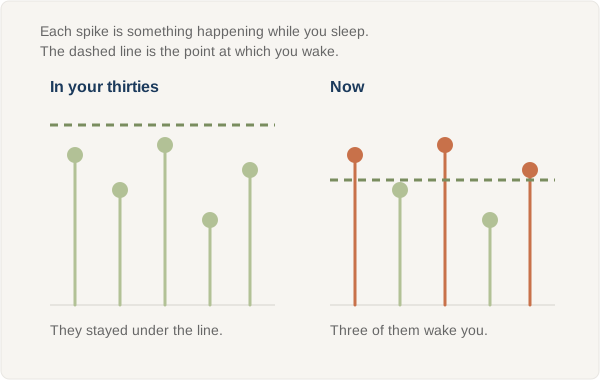
Each spike is something happening while you sleep. A dip in blood sugar, a flush, a noise outside, a thought about tomorrow. All of it was happening at thirty-five too, and you slept through it.
Progesterone is the first hormone to fall in perimenopause, and it falls unevenly. Your body turns progesterone into allopregnanolone, which helps GABA, your brain’s main calming messenger, work better. Less progesterone means less allopregnanolone. GABA still works, it just has less help, and lighter sleep is the result. The dashed line is your waking point. It sits lower now, so a dip in blood sugar or a noise that you slept straight through at thirty-five is enough to push you awake.
What was doing the waking
Blood sugar and adrenaline. Blood sugar drifts down in the small hours, and to lift it back up your body releases adrenaline. Adrenaline is a wake-up signal. In laboratory conditions it starts rising about seven minutes before a person wakes. Insulin resistance is associated with the hormone shifts of perimenopause, so blood sugar can swing more than it used to.
A body clock that has moved. The whole rhythm slides earlier, so you are tired by nine and wide awake at four, then lying there until the alarm goes. Daylight in the morning is what moves it back. In over 400,000 UK adults, each extra hour spent outdoors was associated with waking more easily and fewer insomnia symptoms.
When you eat. In a study of 31 women of average age 62, eating between 8am and 4pm improved measured sleep quality against their own baseline. The same window shifted later, 1pm to 9pm, did not.
Emptying the stress bucket
Sarah Coward of Your Best Mind took the room through the stress bucket: everything you are carrying goes in, and unless something lets it out, it stays at the brim overnight.
In the early evening, get everything out of your head and onto a piece of paper. All of it. Then finish the page with what you did well today, or handled well. Then write that it is alright to rest now, and that everything on the list can wait until tomorrow.
We also talked about the voice you use with yourself through the day, and especially in the evening. Your brain hears every thought and responds to it. “I didn’t get enough done” lands as a threat and keeps you alert. “That was a full day, and the rest can wait” lets you settle.
Why coming together helps
Women who had been awake on their own, assuming they were the only one, sat with other women describing the same nights.
Being with other people dampens the stress response, and it does it faster than working through it alone. Your tolerance for stress falls as hormones shift, so you tip into fight or flight more easily and spend more of your day there. That is exactly when it is worth the most.
The bucket only empties if something lets it out, and connection is one of the things that does it. So is time outside, something creative with your hands, and anything that asks you to slow down rather than get through. These are the first things to go when life is full, and they are the ones worth putting back.
Somebody’s small thing that worked became somebody else’s next experiment. The sharing was as valuable as anything I taught.
One shift
Everyone left having written down one action to focus on.
As women we are very good at doing a lot. During midlife it is so helpful to do a little less where possible. Starting with one change rather than a list means less overwhelm. Pick one thing from this article to begin with, give it seven days and review.
Rebalancing your metabolic health supports you through menopause. We can always improve metabolic health, so there is much hope for feeling better and exiting The 3am Club!
Sources:
Schultes B, Jauch-Chara K, et al. Defective awakening response to nocturnal hypoglycemia in patients with type 1 diabetes mellitus. PLOS Medicine. 2007;4(2):e69. The seven-minute figure comes from the study’s 16 healthy control participants, in whom adrenaline rose 7.5 ± 1.6 minutes before waking. Hypoglycaemia was induced by insulin infusion rather than observed at home.
Burns AC, et al. Time spent in outdoor light is associated with mood, sleep, and circadian rhythm-related outcomes. Journal of Affective Disorders. 2021;295:347-352. Over 400,000 UK Biobank participants; observational.
Peters B, et al. Early but not late time-restricted eating improves an actigraphy-estimated sleep quality in women with overweight or obesity. Frontiers in Nutrition. 2026;13:1823259. Improvements were within the early eating window against baseline. Early and late were not significantly different from each other.