This is part of a four-week series on the Metabolic Quartet, four factors that can impact menopausal experience substantially. This month we’re taking them one at a time. This week: muscle.
The jar that you now need help to open. Stairs that feel harder than they used to. A grip on the shopping bags that isn’t quite what it was. Most women have accepted this as ageing, something to expect and work around as best they can.
Some of it is age. But a good share of these symptoms showing up in your 40s or 50s is sarcopenia, the loss of muscle mass and strength that speeds up through the menopause transition. And it doesn’t stay contained to how strong you feel on the stairs. It impacts blood sugar control and body fat too, which is why muscle is an important part of the Metabolic Quartet alongside the two drivers we’ve already covered.
Learning from research on muscle
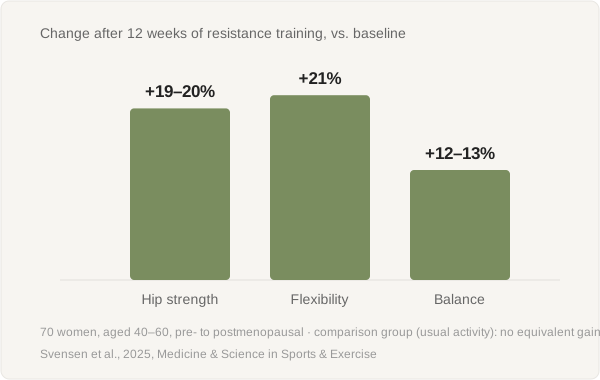
A controlled 12-week trial published in Medicine & Science in Sports & Exercise, put resistance training to the test directly in 70 healthy, moderately active women aged 40 to 60, spanning pre-, peri- and postmenopausal groups. Training four times a week in short, low-impact sessions, with intensity increasing over the 12 weeks, the training group’s hip strength rose by around 19-20%, full-body flexibility by 21%, and balance measures by 12-13%, against a comparison group who kept to their usual activity. Lean muscle increased without a rise in total body weight. The training made a difference regardless of menopause status.
Research also shows that spreading protein across the day, rather than backloading it at dinner, offers some benefit for strength in postmenopausal muscle.
A third study, published in the Bulletin of Faculty of Physical Therapy, followed 150 postmenopausal women and screened them for sarcopenia risk. In early postmenopause, higher physical activity levels were associated with a moderately lower sarcopenia risk score.
Why muscle is more than strength
Muscle is the body’s largest site for clearing glucose from the blood after you eat. Insulin’s main job after a meal is escorting that glucose into muscle tissue, where it’s used or stored. Less muscle means less capacity for that job, so more glucose stays circulating for longer, and blood sugar runs higher and less steady. This connects back to blood sugar and visceral fat: when muscle can’t clear glucose efficiently, your pancreas compensates with more insulin, and chronically high insulin promotes fat storage while blocking its release, linking low muscle mass to visceral fat gain over time.
This is why muscle is an important piece of the Metabolic Quartet. Rebuilding it reaches further than how difficult you find stairs. It supports your underlying metabolic health throughout menopause and beyond.
Working out where you stand
One of the results in Your Menopause Pattern, my free quiz, is “The Fading Strength”. It describes this exact experience: feeling softer or weaker than you were, stairs and grip harder than they used to be, worrying about what your body will be like in ten years.
Muscle responds well to the right training and enough protein.

Rebalancing your metabolic health supports you through menopause whether you decide to use HRT or not, and it runs alongside whatever you and your GP decide.
Next week: chronic stress activation, the fourth driver in the Metabolic Quartet, and what it reveals beyond how stressed you feel.
Sources:
Svensen E, Koscien CP, Alamdari N, Wall BT, Stephens FB. A novel low-impact resistance exercise program increases strength and balance in females irrespective of menopause status. Medicine & Science in Sports & Exercise, 2025;57(3):501-513. DOI: 10.1249/MSS.0000000000003586. PMID: 39480197
Black KE, Matkin-Hussey P. The Impact of Protein in Post-Menopausal Women on Muscle Mass and Strength: A Narrative Review. Physiologia, 2024;4(3):266-285. Published 31 July 2024.
Panhale V, Khatavkar M, Augustine A, Kapasi S. Risk of sarcopenia with physical activity and performance, menopausal symptoms, and QOL in postmenopause. Bulletin of Faculty of Physical Therapy, 2025;30:47. DOI: 10.1186/s43161-025-00306-x